From illiteracy, to literacy, to holiteracy
Our age, and the patterns, impacts, information flows and interconnections we are weaving – and that are weaving us – across unprecedented scales, are challenging us to develop a new form of literacy: a literacy of the whole.
To be effective, to be attentive, to be healthy in this age we need to become: holiterate.*


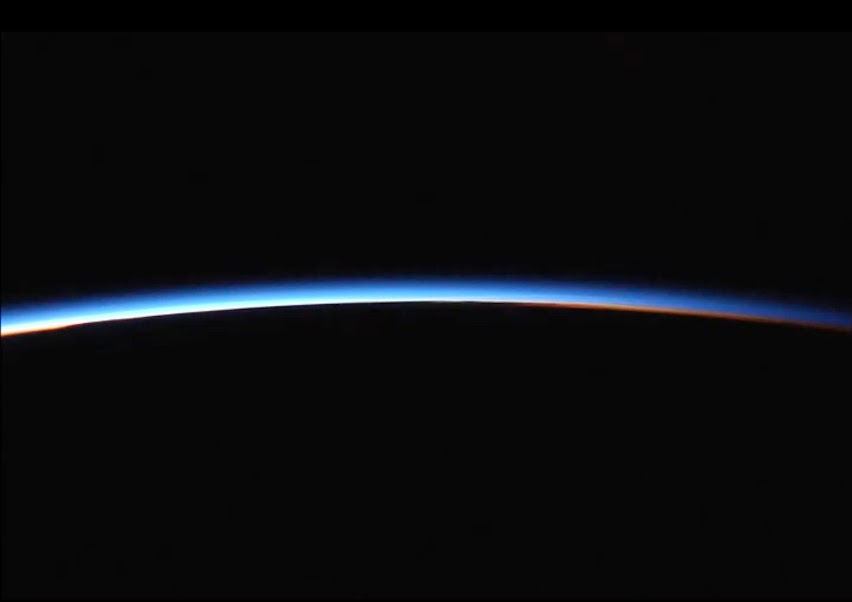
Our existing literacies – still vital – have brought us to a new point of illiteracy. And we stand before the new dimensions and possibilities of this emerging moment as illiterate in our own way as our pre-Mesopotamian and our pre-Gutenberg ancestors.
Aspects of this holiteracy are beginning to shape our understanding, discourse and practice already – visible, for example, in the development of holism, systems thinking, ecology and complexity science, and our enhanced powers of observation across ever smaller and larger scales (and, indeed, in the perception of Daologue, to which I have referred before).
Facets of this emerging holiteracy also appear to resonate with – and to re-emphasise – insights from other ages and other traditions whose different and subtle wisdom has been overwhelmed by the very practical success of our current literacies.
Nonetheless, as a society as a whole, embedded in our familiar institutions, categories and hierarchies, it is hard to escape the sense that we are befuddled in this urgent moment; like the inhabitants of Flatland encountering a sphere for the first time.
Developing this holiteracy – becoming holiterate – requires of us the same patient, playful, iterative, disciplined, learning-in-practice as our other literacies. It requires work and time: and challenges us all now – individually and collectively – to begin to embrace and explore, and to act creatively and wisely, in the new-glimpsed light of this beautifully strange and joyfully unsettling dawning moment.
*…in which the sense of iteration is as salient as the sense of the whole (as, from our limited perspective, the literacy of the whole is always partial, processual, provisional and collaborative).
Daologue
From space we see the Earth as a whole, enveloped in a thin and astonishingly beautiful layer of life; weather systems merging, ocean currents swirling, storm clouds erupting lightning, and night flowing into day across an imperceptibly fluid tectonic landscape.
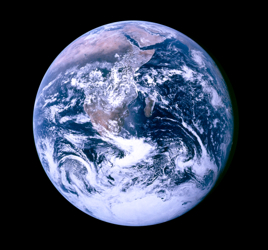
What if we could see our entire planetary conversation flowing in a similar way? What might it look like? Its patterns and themes. Its streams and structures. Its forks and merges. Its bifurcating branches. Its dead ends. Its beautiful possibilities. And how might we listen and act differently given this perception of the conversation of the Earth, this enveloping planetary layer, this connecting and collecting intelligence, this sum of all dialogues: this Daologue?*
Contemplating a lifetime’s conversations, I’m struck by the degree to which our communication feels elevated – healthier – when some sense of Daologue is present: and feels diminished in its absence. Awareness of this additional dimensionality seems to encourage a Copernican shift, a softening iterative provisionality, curiosity, openness, empathy, and an attentiveness to what is not being heard; each of which strengthens our immunity to the pathology that ensues when someone or something speaking saliently to a given situation is not heard.
And yet so much of our public discourse, our party politics, our narcissistic filter bubbles, our sensationalizing media, our vituperative comment streams, feels so far adrift from this quality and possibility – a pathology growing within ourselves as well as between ourselves – and so anachronous and ill-matched to the challenging complexity of the patterns we are creating in the world.
Imbuing our public and private conversations with a greater sense of Daologue might be one of the imperatives of our age. Challenging us to become more literate in understanding and adept at working with this meta-perspective; challenging us to cultivate this awareness and quality within and between ourselves and to cultivate the spaces in which it thrives, and to develop our skills at tending to Daologue. In doing so, I wonder, too, if we might start to conceive of Daologue in its entirety as one of our most precious and uncharted resources; a commonwealth of meaning from which an ever-renewing stream of insight and innovation can be discovered, harvested and shared.
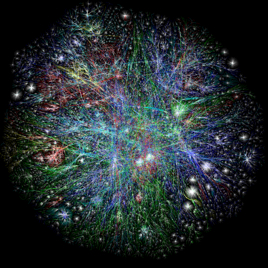
Opte Project: The Internet – 2003
The emergence of the web and our global infrastructure and real-time, social media heighten our awareness and experience of participating in a planetary conversation, and offer startling and tantalizing visual proxies for the structure and flow of Daologue. They also offer new ways to explore, develop our literacy in and empathy towards, and to work creatively with Daologue at unfamiliar scales – and to detect and parse continuously evolving signals from the continuously evolving noise.
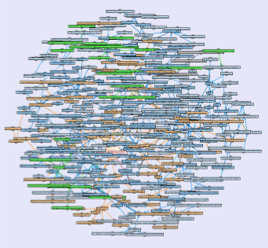
I will expand on this theme in due course. For now though, a first step is simply to notice in wonder that our words and our inner and outer dialogues are always part of this Daologue; permutations of a kaleidoscopic pattern that is continuously forming and reforming, informing and being informed, as an astonishingly beautiful and meaningful whole.
 Get Blog Feed

